|
| |
Auction Items |
|
 |
 |
 |
 |
| Search Auction Criteria |
|
|
 |
| |
|
|
| |
|
|
| |
Lot No.118
AUC69
Ancient World
Silver
Kingdom of Parthia, Mithradates V (128-147 BC), 3.59g, 20.45x24.62 mm, Obv: Diademed bust left, wearing tiara, Rev: Archer seated right on throne, holding bow, monogram below bow Greek legends around. Shore #425. Iridescent Toning, Extremely Fine, Rare.
For bidding the following lot enter the same amount or more then the existing next bid
|
Lot No.119
AUC69
Ancient World
Silver
Sasanian Dynasty, Khusro II (590-628 CE), Silver Dirhem, 4.02g, 30.16x30.44 mm, Obv: Crowned of king facing right, stars and crescents around perimeter, Rev: Holy Zorastrian fire-altar flanked by two attendants, stars and crescents around perimeter. Very Fine, Scarce.
For bidding the following lot enter the same amount or more then the existing next bid
|
Lot No.120
AUC69
Ancient World
Silver
Sasanian Dynasty, Khusro II (590-628 CE), Silver Dirhem, 4.10g, 30.89x32.06 mm, Obv: Crowned bust of king facing right, stars and crescents around perimeter, Rev: Holy Zorastrian fire-altar flanked by two attendants, stars and crescents around perimeter. Very Fine, Scarce.
For bidding the following lot enter the same amount or more then the existing next bid
|
Lot No.121
AUC69
Ancient World
Gold
Roman Empire, Gold Bracteate, 4.63g, 24.79x25.36 mm, Uniface, holed. Fine, Rare.
For bidding the following lot enter the same amount or more then the existing next bid
|
Lot No.122
AUC69
Ancient World
Silver
Roman Imperial, Augustus (27 BC-14 AD), Silver Denarius, 3.78g, 17.80x18.88 mm, Lugdunum Mint, Obv: Laureate head right ‘CAESAR AVGVSTVS DIVI F PATER PATRIAE’, Rev: C L CAESARES AVGVSTI F COS DESIG PRINC IVVENT. Caius and Lucius Caesar standing facing, two shields, two sceptres, lituus and simpulum above. RIC #210. Very Fine, Rare.
For bidding the following lot enter the same amount or more then the existing next bid
|
Lot No.123
AUC69
Ancient World
Copper
Roman Imperial, Claudius II (269-270 AD), Copper Follis, 2.93g, 19.73x17.20 mm, Obv: Bust radiated and with cuirass of Claudius II, around legend: IMP CLAVDIVS AVG, Rev: Genius standing on left carrying patera and cornucopia, around legend. Fine+, Scarce.
For bidding the following lot enter the same amount or more then the existing next bid
|
Lot No.124
AUC69
Ancient World
Copper
Roman Imperial, Constantine I (306-337 AD), Copper Follis, 1.98g, 16.90x16.81 mm, Obv: Bust of Constantine I, laureate, draped, cuirassed, right, Rev: Emperor advancing left, spearing fallen horseman, shield below. Fine+, Scarce.
For bidding the following lot enter the same amount or more then the existing next bid
|
Lot No.125
AUC69
Ancient World
Copper
Roman Imperial, Licinius I (308-324 AD), Copper Follis, 4.76g, 21.22x22.00 mm, Heraclea Mint. Very Fine, Very Scarce.
For bidding the following lot enter the same amount or more then the existing next bid
|
Lot No.126
AUC69
Ancient World
Copper
Roman Imperial, Copper Follis, 3.80g, 20.08x22.98 mm, Obv: Bust to left, Re:. Procopius standing left. Fine+, Scarce.
For bidding the following lot enter the same amount or more then the existing next bid
|
Lot No.127
AUC69
Ancient World
Copper
Roman Imperial, Constantine I (327-329 AD), Copper Follis, 2.79g, 18.69x19.86 mm, Nicomedia Mint, Obv: Head of Constantine I, laureate, right, Rev: Camp gate with two turrets, without doors, with varying number of stone layers, star above. Very Fine, Very Scarce.
For bidding the following lot enter the same amount or more then the existing next bid
|
Lot No.128
AUC69
Ancient World
Copper
Roman Imperial, Constantine I (327-329 AD), Copper Follis, 2.22g, 16.54x16.59 mm, Heraclea Mint, Obv: Bust of Constantinopolis, left, laureate, helmeted, wearing imperial cloak, a reversed spear on left shoulder, Rev: Anepigraphic. Winged Victory, standing to left on a prow, draped, holding spear in right hand and resting left hand on shield, A dot before the prow. RIC VII #135. About Very Fine, Very Scarce.
For bidding the following lot enter the same amount or more then the existing next bid
|
Lot No.129
AUC69
Ancient World
Electrum
Ancient Greece, Ionia Region, Circulation Era: 625 - 600 BCE, Standard: Phokaic, Denomination: 1 Myshemihekte = 1 / 24 Stater (28/24), Metal: EL Electrum, 0.45g, 6.33x6.42 mm, Obv: Raised clockwise Swastika pattern, Rev: Quadripartite square punch. Attributions: Karwiese, Artemision, Type II.7, Traite I 237, Elektron I 44, SNG Kayhan 702 var. (Swastika counterclockwise). Extremely Fine. Rare.
For bidding the following lot enter the same amount or more then the existing next bid
|
Lot No.130
AUC69
Ancient World
Silver
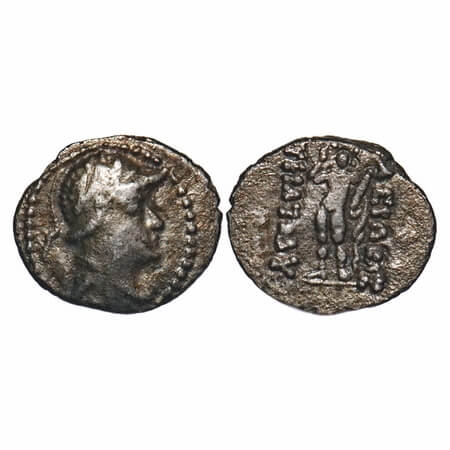
Greco-Baktrian Kingdom, Bactria Region, Eucratides I Megas, Circulation Era: 170 - 145 BCE, Denomination: Obol, Silver, 0.46g, 9.43x10.87 mm, Obv: Draped, diademed, cuirassed & armored bust facing right wearing a crested Boeotian helmet (covered with pelt of scales & adorned with wing), decorated with bull's horns & ears, and surmounted by an aegis, All within a decorative dotted border which is rarely seen in-full, on-flan on this extremely rare type, Rev: Naked Demi-God Heracles (Hercules) standing front facing holding club & Nemean lion skin in its left hand, crowning himself with his right hand, BASILEYES / EYKPATIDIODOY, Transliteration: Of King Eucratides. P.S: Appearing for the first time in any Indian Auction. The obverse portrait of this unusual coin series bears strong similarities to the helmeted ruler's bust on the drachmas of Heliocles I – the helmet is decorated with a network of scales, likely the aegis of Medusa. The reverse motif of a standing naked Demi-God Heracles (Hercules) is taken from the Tetradrachms of Demetrius I, which is otherwise unprecedented in Eucratides' coinage. This evidence could suggest that the Obols were only minted after the death of king Eucratides I. Attribution: HGC 12, 140-141; SNG ANS 612-615; Mitchiner 1, 167a. Extremely Fine+. (Double RR - Rarity quotient as per type), Extremely Rare. .
For bidding the following lot enter the same amount or more then the existing next bid
|
Lot No.131
AUC69
Ancient World
Silver
Kingdom of Parthia, Vologases VI (208-228 AD), Silver Drachm, 3.57g, 20.18x19.55 mm, Obv: Diademed bust left, wearing tiara with earflap; wl in Aramaic to right, Rev: Archer seated right on throne, holding bow, monogram below bow Greek legends around. Shore #458. Iridescent toning, Extremely Fine, Rare.
For bidding the following lot enter the same amount or more then the existing next bid
|
Lot No.132
AUC69
Ancient World
Gold
Italy, Republic of Venice, Andrea Dandolo(1342-1354 AD), Gold Ducait, 3.45g, 19.65x20.02 mm, Obv: St. Mark standing at left presenting staff, with pennant and DVX vertically at top, to doge kneeling at right, Rev: Full-length facing figure of Christ in beaded ellipse lined with stars. About Very Fine, Very Scarce.
For bidding the following lot enter the same amount or more then the existing next bid
|
Lot No.133
AUC69
Ancient World
Silver
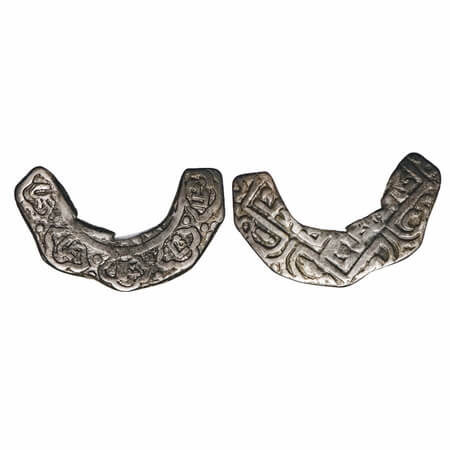
Nepal, Pratap Simha, Officially struck by the Nepali Ruler, Circulation Region: Used in the Autonomous region of Tibet, Denomination: Hand cut fractional Mohars - 5 Petal - 1 Sho (denomination of Tibetan coin which is the largest denomination with 5 petals), Silver, 1.34g, 14.44x24.87 mm, As Tibet lacked a standard low-denomination fractional currency system in the 18th century, whole silver Mohar coins minted in Kathmandu were purposefully cut into fractions by merchants to serve as small changes in Tibetan markets. The 1-Sho Piece: In this fractional system, a piece cut straight across retaining five petals of the original eight-petal floral design was designated as a 1-Sho denomination. It represents Nepal's cut fractional Mohar coinage struck specifically for export & circulation in Tibet during the reign of King Pratapa Simha Shah (1775 - 1777 CE). (Offered for the first time in an Indian Auction. Sold once in Spink China - The Nicholas Rhodes Collection - Coins of Tibet.),Very Fine+. Extremely Rare.
For bidding the following lot enter the same amount or more then the existing next bid
|
|
|
|
|
 |
|
| Notification: Your IP is :
216.73.216.69
. We log IP addresses for security reasons. |
|
|
|